
Cursor Compile 26: Inside Cursor's First Conference and What It Means for AI-Native Development
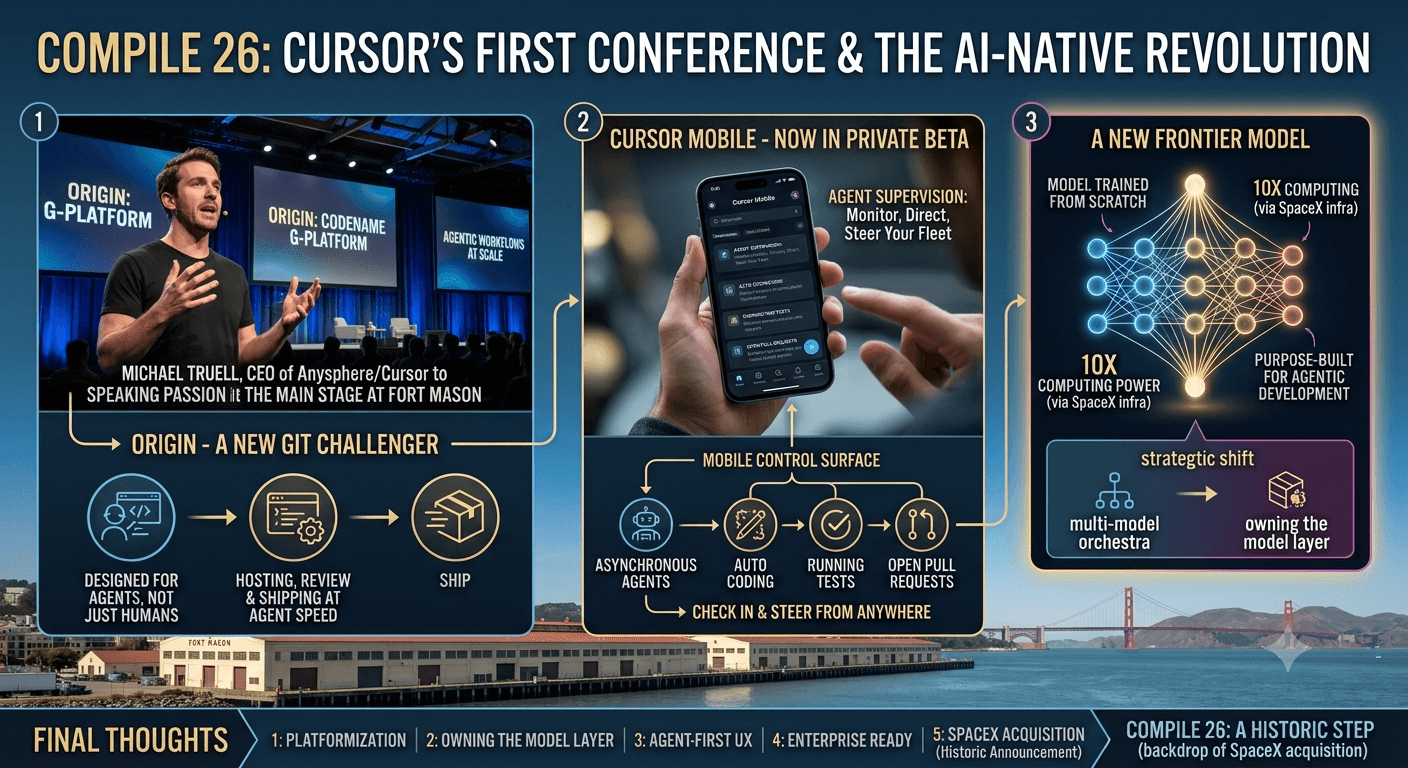
On June 16, 2026, Cursor stepped out from behind the editor and onto a stage. Compile was the company's first-ever conference — a one-day, invite-only gathering at Fort Mason in San Francisco, bringing together engineers, researchers, and builders to talk about where software is headed. It was part product launch, part cultural statement: Cursor isn't just an AI-powered code editor anymore. It's positioning itself as a platform for how software gets built in an agentic, AI-native era.
The event landed at an especially dramatic moment — news broke that SpaceX had acquired Cursor's parent company, Anysphere, just hours before CEO Michael Truell took the stage. Between the acquisition news and a slate of major product announcements, Compile 26 quickly became one of the most talked-about developer events of the year.
Here's a full breakdown of what happened, what was announced, and why it matters.
What Exactly Was Compile 26?
Compile was deliberately intimate. Rather than a sprawling expo with thousands of attendees, Cursor invited a curated group of engineers, researchers, designers, and builders for a single day of talks and conversation. The agenda leaned on depth over spectacle — including a "Chalkboard Stage," where speakers worked through ideas live using nothing but a board and chalk, in the spirit of Kurt Vonnegut's famous "Shapes of Stories" lecture.
Speakers included:
- Michael Truell — Cursor co-founder and CEO
- Ryo Lu — Cursor's product design lead
- Dan Shipper — CEO of Every
- Pieter Levels — independent maker and founder
- Sam Lambert — of PlanetScale
- Claire Vo — of ChatPRD
The submissions for the Chalkboard Stage focused on themes like agentic coding workflows at scale, context engineering and retrieval, multi-model orchestration, and real-world stories of AI pair programming — giving a strong hint at where Cursor sees the next phase of software development heading.
The Big Announcements
Michael Truell's keynote, joined by Kevin Niparko (Product Lead for Cloud Agents) and Tomas Reimers (Product Lead for Origin), unveiled three major initiatives.
1. Origin — A New Git Platform
The headline announcement was Origin, Cursor's own code-hosting and review platform — effectively a challenger to GitHub, but built specifically for an agentic development workflow rather than a human-first one. Instead of retrofitting existing tools for AI agents, Origin is designed from the ground up around how autonomous coding agents actually work: reviewing, hosting, and shipping code at agent speed. A waitlist for Origin opened immediately after the announcement.
2. Cursor Mobile — Now in Private Beta
Cursor also announced Cursor Mobile, giving developers the ability to monitor, direct, and interact with their coding agents from a phone. This continues a broader industry shift toward agents that work asynchronously in the background — writing code, running tests, and opening pull requests — while developers check in and steer from wherever they are, rather than being tied to a desktop session.
3. A New Frontier Model, Trained From Scratch
Perhaps the most significant long-term announcement: Cursor confirmed it is training its first model built entirely from scratch, rather than fine-tuning or wrapping third-party foundation models. According to reporting around the event, this effort is being developed with significantly more compute — reportedly around 10x more than prior efforts — and in partnership with SpaceX's compute infrastructure following the acquisition. The goal is a model purpose-built to push agentic software development further than general-purpose coding assistants can.
This is a meaningful strategic shift. Cursor built its reputation as a multi-model orchestration layer — letting developers choose between models from various providers. Training a frontier model from scratch signals ambitions to compete more directly at the model layer itself, not just the tooling layer around it.
Why Compile 26 Matters
Taken together, the announcements paint a clear picture of where Cursor wants to go: from an AI-assisted code editor to a full agentic software platform — one that owns the model, the hosting layer, and the mobile control surface for autonomous coding agents.
A few reasons this shift matters:
- Platformization. By launching Origin, Cursor is no longer content to sit on top of GitHub. It wants to own the entire lifecycle of agent-written code — from generation to review to hosting.
- Owning the model layer. A custom frontier model, trained with dramatically more compute, suggests Cursor wants tighter control over the coding-specific capabilities that matter most to its users, rather than depending entirely on external labs.
- Agent-first UX. Cursor Mobile reflects a broader trend: developers increasingly supervise fleets of agents rather than write every line of code themselves. Mobile access turns coding agents into something closer to a background employee you check in on.
- Enterprise readiness. Cursor's growing integrations (GitHub, GitLab, Slack, Linear, JetBrains) and governance features (SSO, SCIM, audit logs) show it's positioning all of this — Origin, the new model, mobile agents — as infrastructure serious engineering organizations can adopt at scale, not just a hobbyist tool.
The SpaceX Acquisition Backdrop
It's hard to talk about Compile 26 without mentioning the news that broke the same day: SpaceX's acquisition of Anysphere, Cursor's parent company. The timing turned what might have been a standard product keynote into something attendees described as historic — a company announcing a major new strategic direction for software development literally hours after becoming part of one of the world's most ambitious engineering organizations. Whether or how this relationship shapes Cursor's compute access, roadmap, or long-term direction is something to watch closely in the months ahead.
What to Watch Next
For teams and individual developers trying to make sense of the Compile 26 news, a few practical threads are worth tracking:
- Origin's rollout — when it moves from waitlist to general availability, and how it compares to GitHub for agent-heavy workflows.
- The new frontier model — its release timeline, benchmarks, and whether it becomes the default engine behind Cursor's agents.
- Cursor Mobile's beta — how mobile agent supervision changes daily developer workflows once it's broadly available.
- Cursor's multi-model strategy — whether owning a proprietary model changes how Cursor positions its existing support for models from other providers.
Final Thoughts
Compile 26 wasn't just a product showcase — it was Cursor publicly staking a claim as a serious platform player in the AI-native software era, not merely a popular editor plugin. Between Origin, Cursor Mobile, and a from-scratch frontier model, the announcements suggest Cursor is betting that the future of software development belongs to companies that control the full agentic stack: the model, the workflow, and the place code lives.
Whether that bet pays off will depend on execution over the coming months — but Compile 26 made clear that Cursor intends to be at the center of that shift.
Want more breakdowns of the latest developer tools and AI product launches? Explore more articles on mushoodhanif.com.