Losono
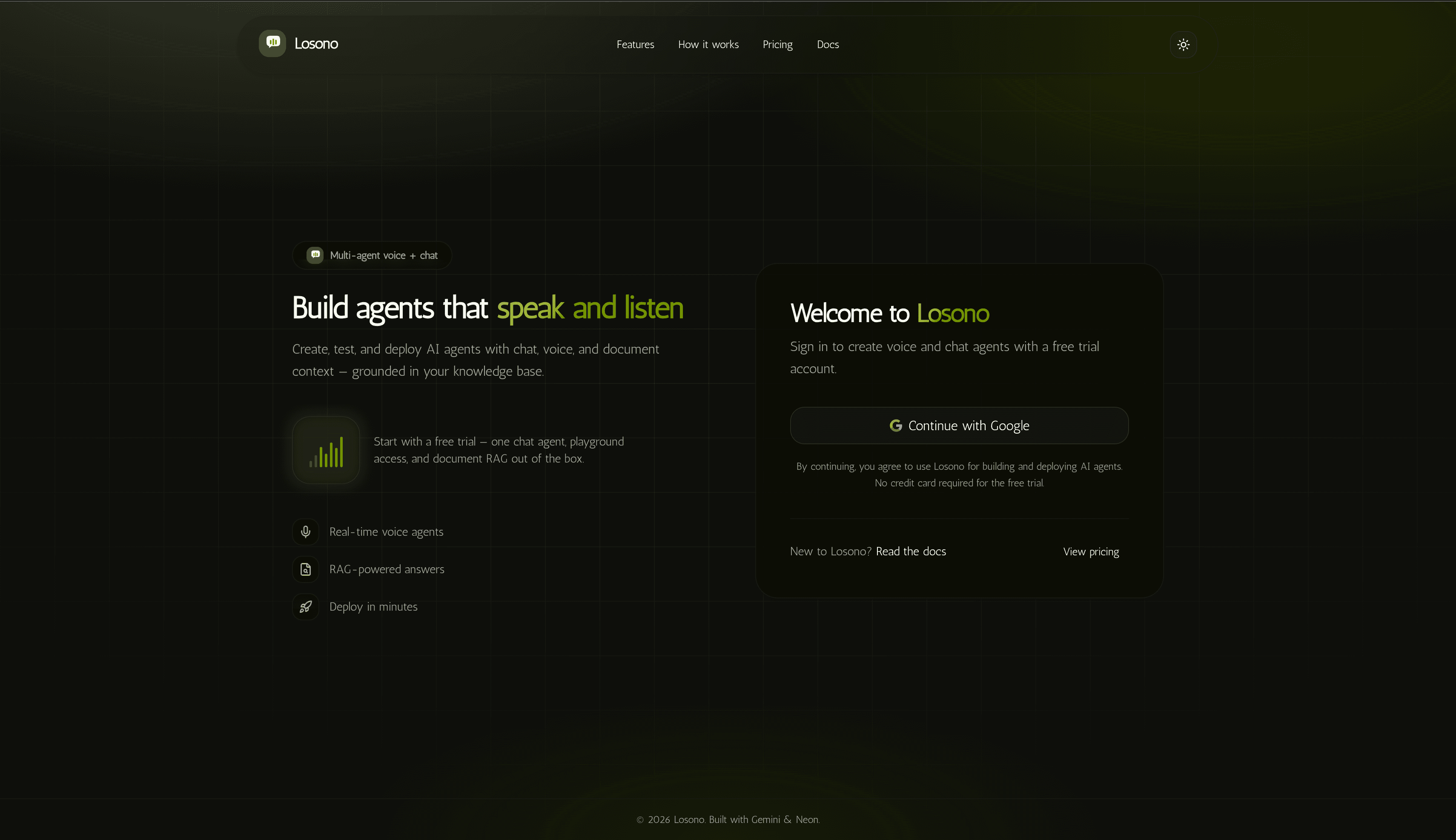
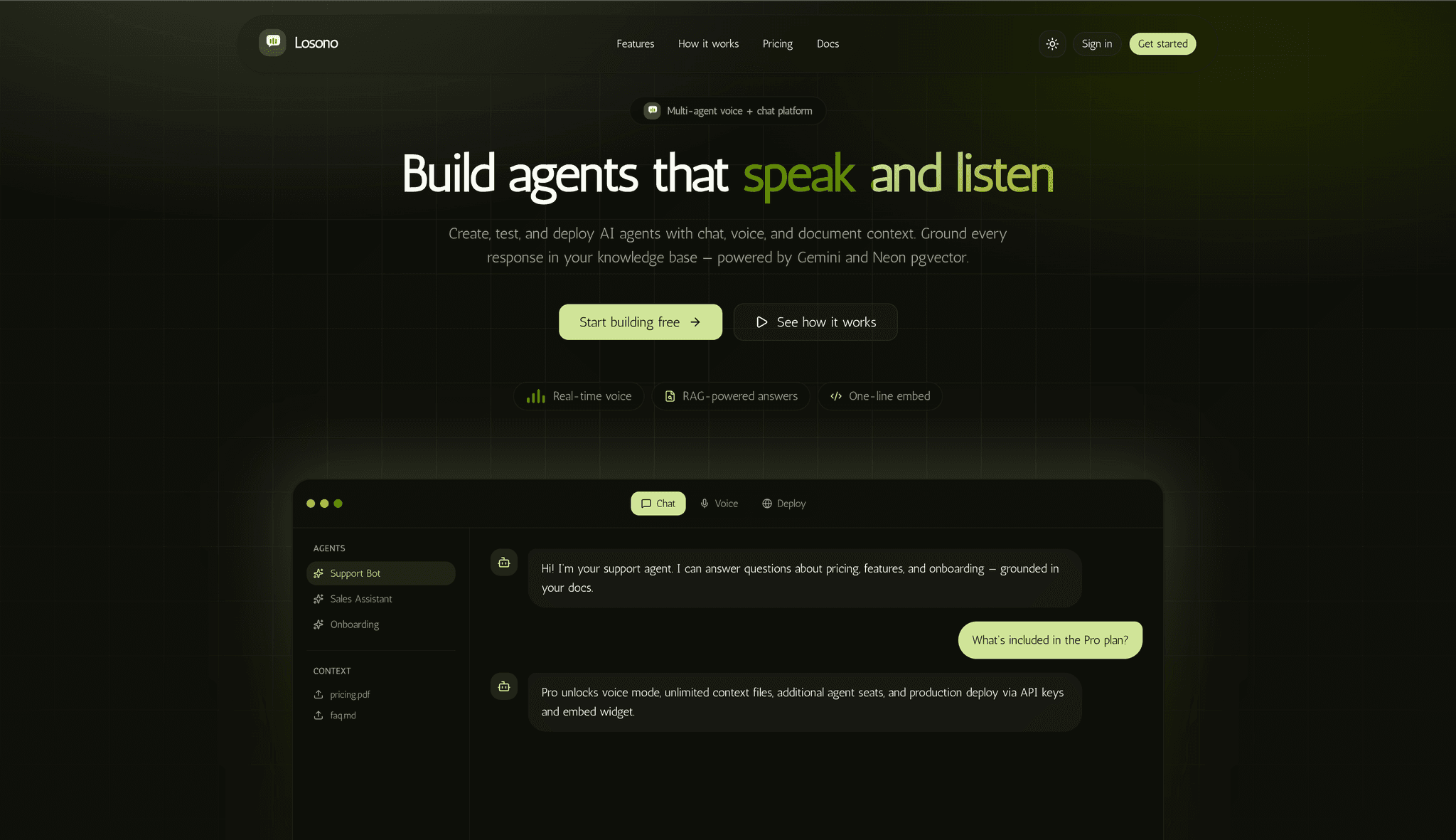
Build AI agents that chat, speak, listen, and answer using your knowledge base.
Conversational AI · Founder · 1 month · Team of 1
Problem
Organizations increasingly want AI-powered assistants for customer support, sales, onboarding, and internal knowledge access. However, building production-ready AI agents requires combining multiple complex systems, including prompt management, document retrieval, voice infrastructure, authentication, deployment pipelines, usage tracking, and billing. Most teams either build these components from scratch or rely on fragmented tools that create operational overhead and inconsistent user experiences.
Context
Losono was designed as a unified platform for creating, testing, and deploying AI agents across both chat and voice interfaces. The goal was to eliminate the need for organizations to assemble separate solutions for conversational AI, retrieval-augmented generation (RAG), voice communication, deployment, and developer integrations.
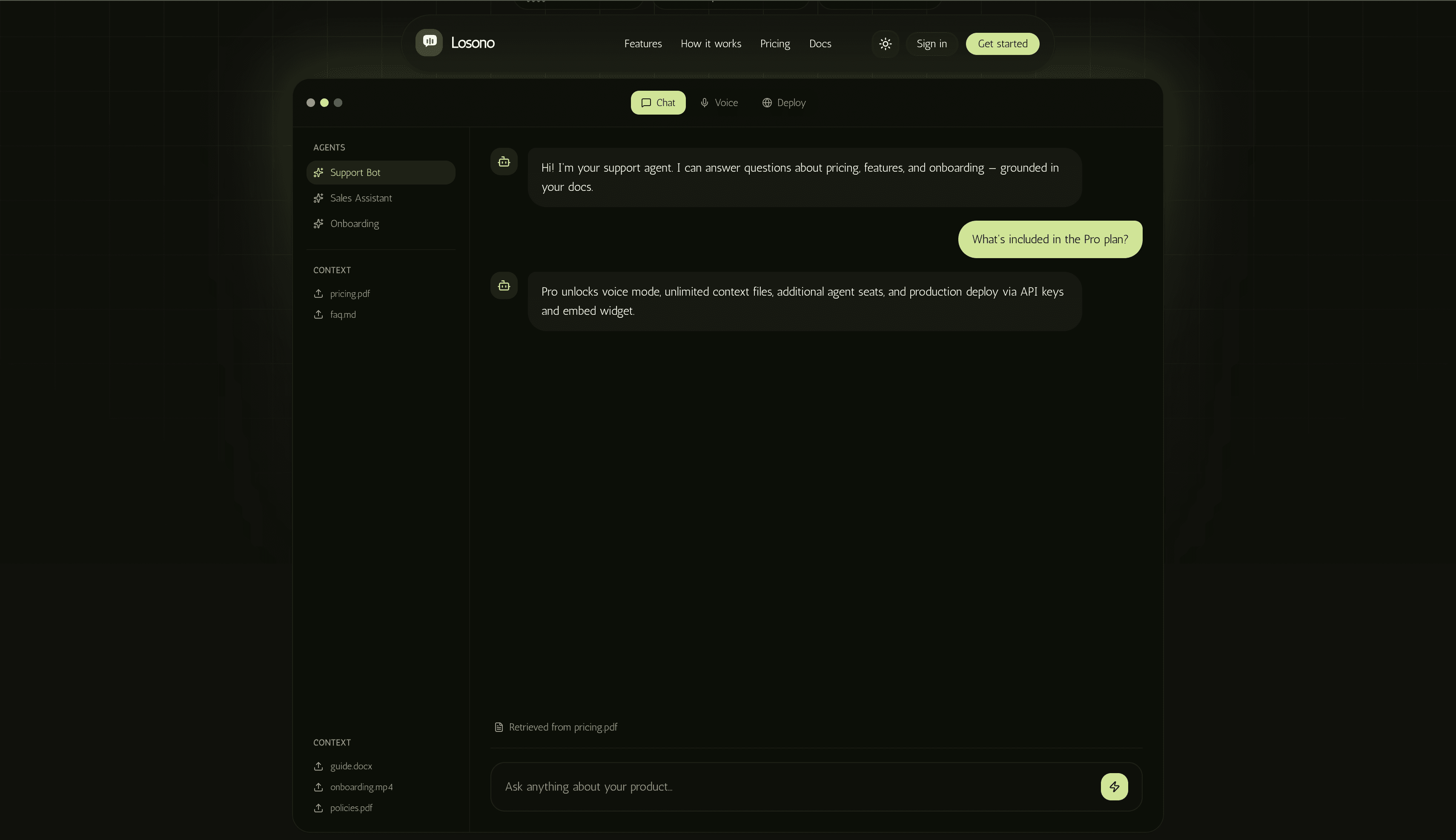
The platform supports multiple specialized agents, each with independent prompts, knowledge bases, deployment settings, and access controls, enabling teams to create purpose-built assistants for various business functions.
Strategy
The product strategy focused on four core principles:
- Multi-Agent First — Enable organizations to create specialized agents instead of relying on a single general-purpose assistant.
- Voice and Chat Parity — Provide the same intelligence layer across both text and voice experiences.
- Developer-Friendly Deployment — Offer multiple integration methods including REST APIs, WebSockets, and embeddable widgets.
- Knowledge-Grounded Responses — Use retrieval-augmented generation to ensure responses are based on organization-specific content rather than model memory alone.
This approach positioned Losono as both a no-code agent management platform and a developer platform for AI-powered applications.
Architecture
Losono is built as a modern AI-native SaaS platform.
Frontend
- Next.js 16
- React 19
- Tailwind CSS 4
- shadcn/ui
- Radix UI
Authentication
- NextAuth v5
- Google OAuth
Data Layer
- Neon PostgreSQL
- Drizzle ORM
- pgvector
AI Infrastructure
- Google Gemini
- Gemini Live
- Gemini Embeddings
- Vercel AI SDK
Platform Services
- Stripe Billing
- Agent Management
- Document Processing Pipeline
- Conversation Logging
- API Key Management
Deployment Channels
- REST Chat API
- WebSocket Voice API
- Embedded Website Widget
Execution
The platform was developed around a complete agent lifecycle.
- Agent creation and configuration
- Knowledge base ingestion and indexing
- Playground-based testing for chat and voice
- Publishing and deployment workflows
- API key generation and access management
- Usage tracking and billing integration
Document ingestion pipelines were implemented to process multiple content formats, generate embeddings, and store vector representations for semantic retrieval. Real-time chat streaming and voice communication were integrated to provide low-latency conversational experiences across deployment channels.
Challenges
Real-Time Voice Infrastructure
Maintaining low-latency bidirectional communication for voice conversations while preserving conversational context required careful WebSocket architecture and streaming orchestration.
Multi-Format Knowledge Processing
Supporting PDFs, documents, markdown, images, audio, and video required a flexible ingestion pipeline capable of extracting meaningful content regardless of source format.
Retrieval Quality
Ensuring that agents consistently returned relevant context while minimizing hallucinations required tuning chunking strategies, embedding workflows, and retrieval mechanisms.
Multi-Tenant Agent Isolation
Each agent needed complete separation of prompts, knowledge bases, API credentials, deployment settings, and usage tracking without introducing operational complexity.
Production Deployment Experience
Balancing ease of deployment with security, scalability, and billing enforcement required a robust publishing and access management system.
Solution
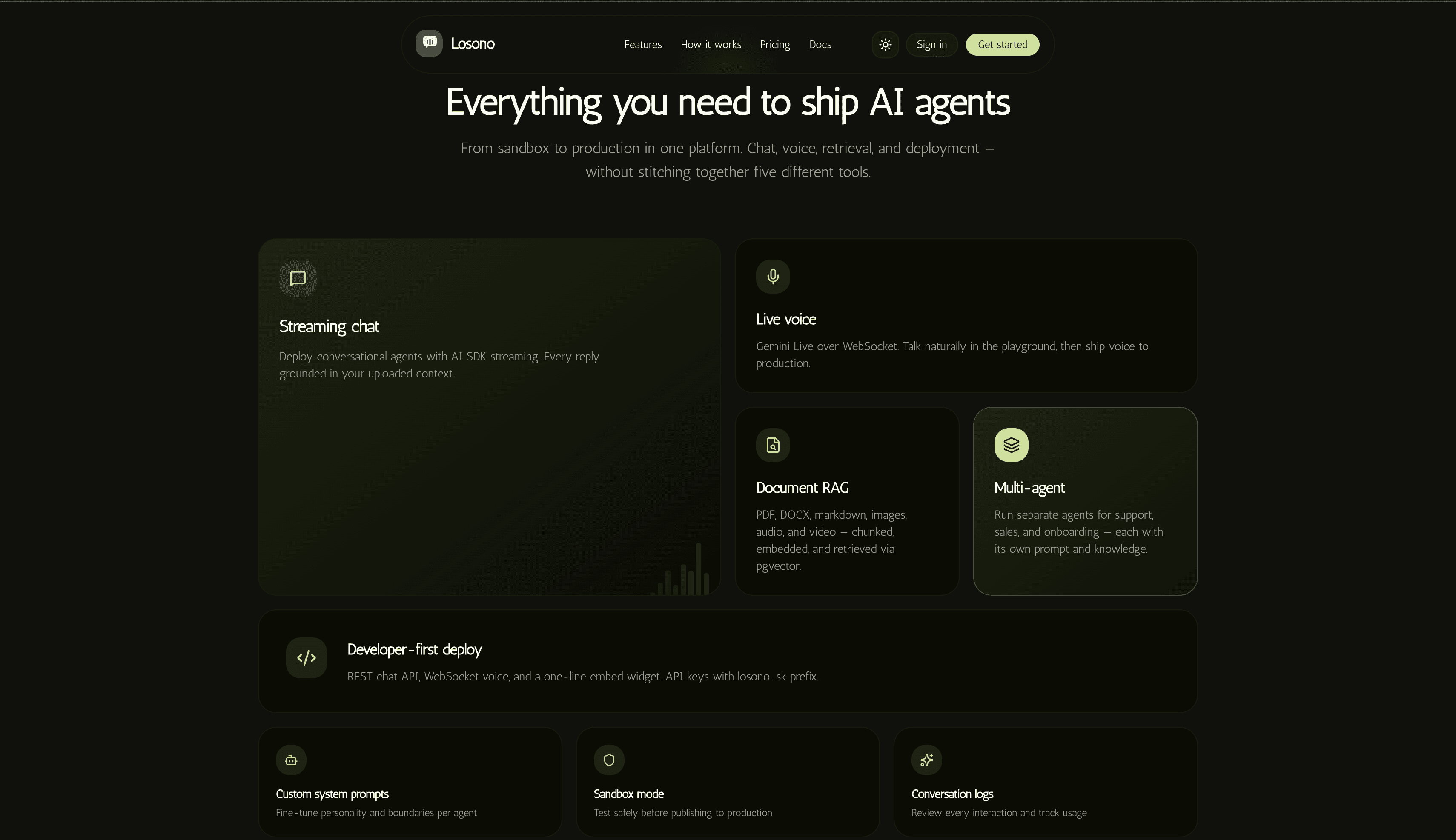
Losono centralizes the entire AI agent development and deployment workflow into a single platform.
Organizations can create specialized agents, upload knowledge sources, test interactions in a sandbox environment, and deploy production-ready chat and voice experiences through APIs or embeddable widgets.
The platform combines:
- Multi-agent management
- Retrieval-augmented generation
- Real-time voice communication
- Streaming chat
- Developer APIs
- Usage analytics
- Subscription billing
into a unified developer and business experience.
Measurable impact
Losono significantly reduces the complexity involved in launching production-ready AI assistants.
Key outcomes include:
- Faster time-to-deployment for conversational AI projects
- Reduced infrastructure complexity through a unified platform
- Improved response quality through document-grounded retrieval
- Consistent deployment across chat and voice channels
- Simplified integration through APIs and embeddable widgets
- Scalable multi-agent architecture for different business functions
- Centralized management of prompts, knowledge, deployment, and billing
Tech & infrastructure
Tech Stack
Infrastructure
Integrations
Gallery