HackerRank Open-Sourced Its AI Hiring Agent: How the ATS Really Evaluates Your Resume | Mushood Hanif
Home / Blog / HackerRank Just Open-Sourced Their AI Hiring Agent — Here's What It Actually Evaluates Insights
HackerRank Just Open-Sourced Their AI Hiring Agent — Here's What It Actually Evaluates For years, developers have wondered what happens after uploading a resume into an ATS. HackerRank has just removed much of that mystery by open-sourcing its internal AI Hiring Agent. Here's how it works, what it evaluates, why it matters, and what every software engineer should learn from reading its source code.
Featured • hackerrank • June 28, 2026
HackerRank Just Open-Sourced Their AI Hiring Agent — Here's What It Actually Evaluates
For years, Applicant Tracking Systems (ATS) have been treated like mysterious black boxes.
Candidates optimize keywords.
Recruiters promise "humans review every resume."
Developers speculate endlessly about why one resume succeeds while another is rejected.
Now, that mystery has become significantly smaller.
HackerRank has open-sourced the AI Hiring Agent they use to evaluate resumes.
Link to Repository
This isn't another resume checker built by an independent developer.
This is an actual production-inspired hiring pipeline released by one of the world's largest technical hiring platforms.
And it's fascinating.
This Is Not Just Another ATS
Traditional ATS software primarily stores resumes and searches keywords.
The Hiring Agent goes much further.
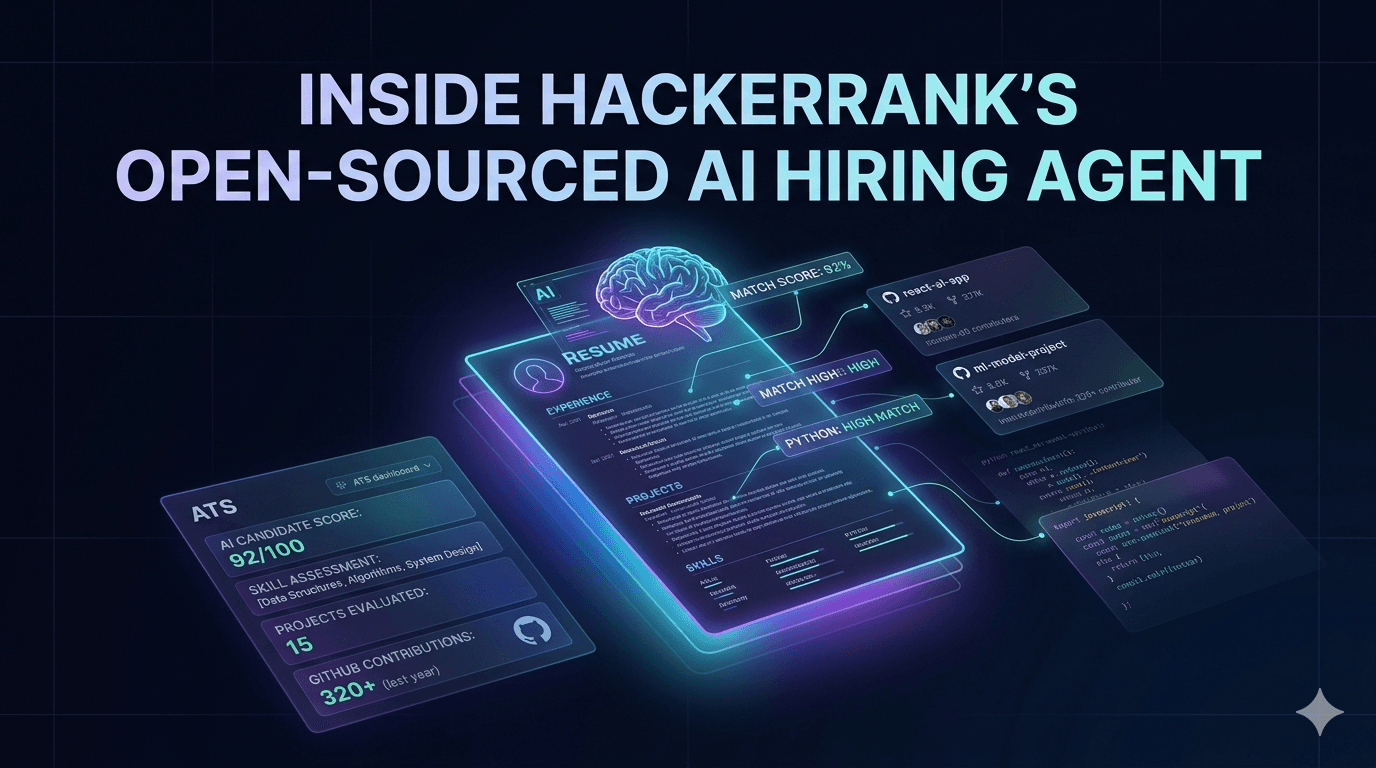
Instead of simply checking whether "React" appears on your resume, it attempts to understand your technical profile.
The pipeline:
Reads your resume PDF.
Converts it into structured Markdown.
Uses an LLM to extract information into structured JSON.
Fetches your GitHub profile.
Analyzes repositories.
Selects your strongest projects.
Evaluates your engineering experience.
Produces detailed scoring with evidence. Instead of a simple keyword score, it generates an actual engineering evaluation.
The Architecture The repository reveals a surprisingly clean architecture.
Resume PDF
      │
      ▼
PDF → Markdown
      │
      ▼
LLM Structured Extraction
      │
      ▼
GitHub Enrichment
      │
      ▼
Project Classification
      │
      ▼
AI Evaluation
      │
      ▼
Final Score + Evidence
Each stage has a dedicated responsibility, making the project relatively easy to understand.
Some notable modules include:
PDF parsing
Prompt templates
GitHub analysis
Project ranking
Resume scoring
Evidence generation
It's an elegant example of building an AI pipeline around deterministic software rather than relying entirely on prompting.
The Most Interesting Part The evaluator doesn't only inspect your resume.
It attempts to validate what you've actually built.
Instead of accepting a project title at face value, it looks deeper into repositories to identify stronger engineering signals.
That immediately reduces one of the biggest weaknesses of traditional ATS systems:
Anyone can write "Built an AI platform."
Much harder is proving it.
What It Actually Rewards Reading through the repository makes one thing clear.
The agent values evidence .
Strong GitHub repositories
Technical depth
Meaningful open-source contributions
Engineering complexity
Demonstrated impact
Real work over buzzwords
That's a significant shift from older ATS systems that focused primarily on keyword matching.
Can You Game It? Could you stuff your resume with AI buzzwords?
Would that produce a better evaluation?
Because the system attempts to correlate your claims with your projects and GitHub profile.
The emphasis is no longer on saying the right things.
It's on showing your work.
Why This Matters Whether you're a student or a senior engineer, this repository offers a rare opportunity.
Most hiring systems are proprietary.
prompts
scoring logic
evaluation criteria
architecture
engineering decisions
That transparency benefits both developers and recruiters.
Instead of guessing what hiring software wants, you can study it directly.
What Developers Should Learn This repository is valuable for reasons beyond resume optimization.
It's an excellent example of modern AI engineering.
Retrieval pipelines
LLM orchestration
Structured extraction
Prompt engineering
Deterministic workflows
GitHub API integration
AI evaluation pipelines
If you're trying to become an AI Engineer, this repository is almost a free case study.
The Bigger Picture The real lesson isn't how to beat an ATS.
It's that hiring is changing.
Companies are increasingly looking beyond keyword matching and toward measurable engineering signals.
Build real projects.
Contribute to open source.
Write technical blogs.
Maintain an active GitHub profile.
Show evidence of engineering decisions.
Those signals are becoming much harder to fake—and much more valuable.
Final Thoughts Open-sourcing an internal hiring agent is an unusual move.
Whether you're job hunting, building AI systems, or simply curious about modern hiring, this repository is worth exploring.
It won't guarantee you a job.
But it will help you understand how modern AI-assisted resume evaluation actually works.
And in today's hiring landscape, understanding the system is already an advantage.