Resident Evil Star Milla Jovovich Built MemPalace—A Breakthrough AI Memory System for Agents | Mushood Hanif
Insights
Resident Evil's Milla Jovovich Just Built One of the Best AI Memory Systems Ever. Yes, Seriously.
Hollywood actress Milla Jovovich wasn't on anyone's list of AI infrastructure builders. Yet she just co-created MemPalace, an open-source memory framework for AI agents that claims state-of-the-art benchmark results while running entirely on your own machine. More importantly, it challenges how we think AI should remember.
Featured•milla jovovich•
Resident Evil's Milla Jovovich Just Built One of the Best AI Memory Systems Ever. Yes, Seriously.
Every few weeks, the AI world produces a headline that sounds completely made up.
This week's winner?
Milla Jovovich—best known for Resident Evil and The Fifth Element—has co-created an open-source memory system for AI agents called MemPalace. And according to its published benchmarks, it ranks among the strongest-performing memory frameworks available today.
No, this isn't a celebrity licensing their name onto someone else's startup.
According to the project, Jovovich designed the memory architecture after becoming frustrated while building AI-assisted creative projects. Veteran software engineer Ben Sigman implemented and engineered the system into a production-ready framework.
The Real Problem Isn't Intelligence
Large language models have become incredibly capable.
But they still suffer from a fundamental limitation.
They forget.
Close a conversation.
Start tomorrow.
Much of your context disappears.
Developers have spent the last two years trying to solve this through:
gigantic context windows
vector databases
RAG
summarization
knowledge graphs
Each helps.
None completely solve long-term memory.
MemPalace takes a different approach.
Instead of Summarizing... It Remembers
Most AI memory systems ask:
"What should we save?"
MemPalace asks a different question:
"Why throw anything away?"
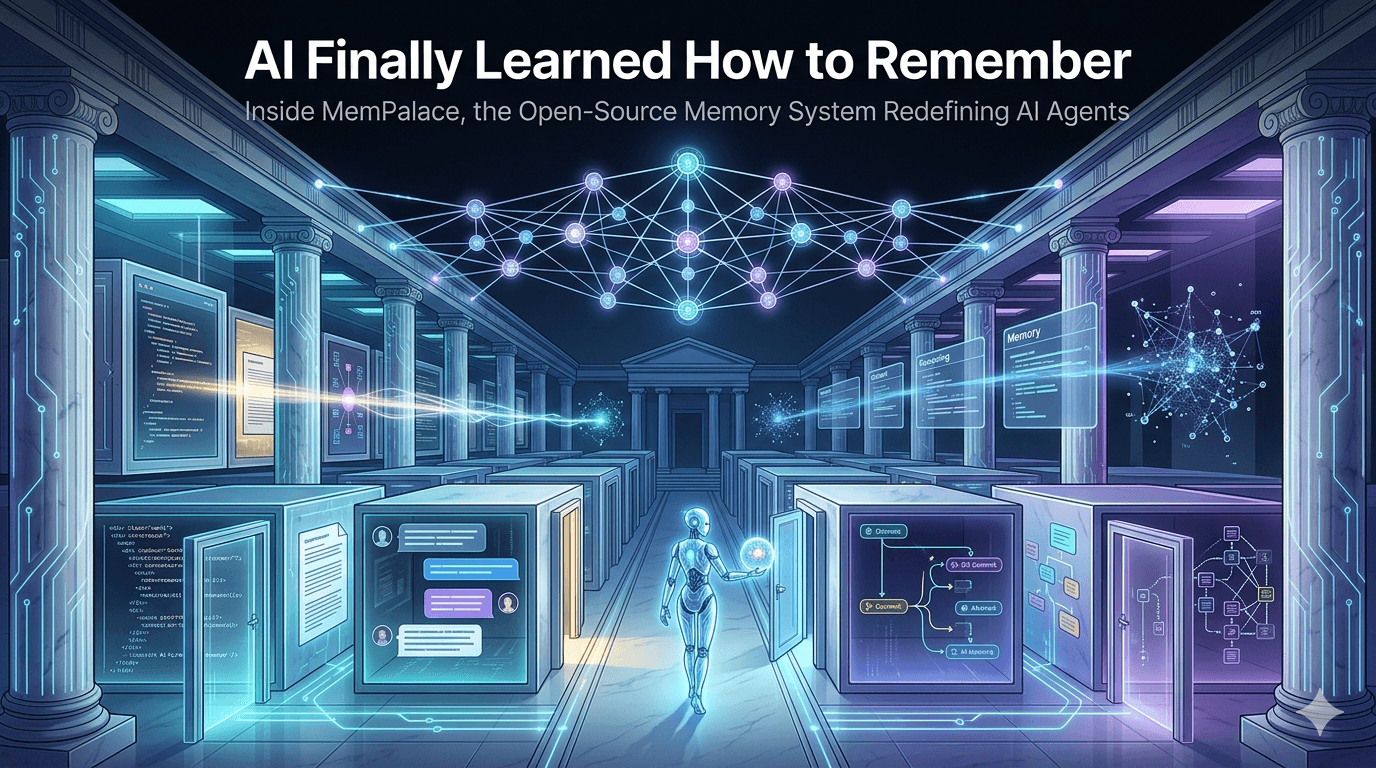
Instead of aggressively compressing conversations into summaries, it stores the original information verbatim and organizes it using the ancient "Memory Palace" (Method of Loci) concept.
Rather than a flat vector database, memories are arranged into structured spaces—people become wings, topics become rooms, and conversations become searchable objects within them.
Ancient Greece Meets Modern AI
The inspiration is surprisingly old.
More than two thousand years ago, Greek and Roman orators memorized enormous speeches using the Method of Loci.
They mentally walked through an imaginary building.
Each room contained memories.
To recall information, they simply walked through that palace in their mind.
MemPalace applies the same philosophy to AI.
Instead of storing isolated vectors, it creates structured memory spaces that make retrieval more precise and easier to scope.
Why This Is Different
The project isn't just another vector database wrapper.
Its architecture focuses on three ideas:
Preserve original conversations.
Organize memories hierarchically.
Retrieve only what matters.
That may sound simple.
But AI agents spend a surprising amount of time failing because they retrieve either too much context or the wrong context.
Better retrieval often matters more than larger context windows.
The Benchmark Everyone Is Talking About
MemPalace claims impressive results on LongMemEval, a benchmark designed to measure long-term memory retrieval for AI systems.
The project reports:
96.6% R@5 without external API calls.
100% recall using a hybrid reranking configuration.
Those numbers have attracted significant attention—but also healthy skepticism from parts of the AI community, who want to see broader independent validation and real-world testing. That's a normal and useful part of evaluating new infrastructure projects.
Why AI Engineers Should Care
Whether the benchmark ultimately holds isn't the most interesting part.
The bigger lesson is architectural.
We're moving beyond treating memory as "retrieve the closest embedding."
Modern AI agents increasingly need memory that can:
persist across sessions
preserve reasoning
organize context
retrieve selectively
remain fully local
support auditability
Memory is becoming infrastructure—not just another prompt enhancement.
Local-First Matters
Another notable design decision:
Everything runs locally.
No mandatory cloud APIs.
No recurring subscription.
No hidden memory service storing your conversations.
For developers building coding agents or enterprise assistants, that alone makes the project worth exploring.
The Most Surprising Part
Honestly...
The biggest surprise isn't that an actress helped build an AI memory framework.
It's that she identified a real engineering problem before many companies did.
Jovovich has described repeatedly losing valuable AI context during creative work and asking a simple question:
Why can't AI remember the way humans organize memories?
That question ultimately became MemPalace.
A Bigger Trend Is Emerging
Over the past few months we've seen a pattern emerge.
Developers are no longer obsessed with building larger models.
Instead they're building better systems around those models:
orchestration
memory
evaluation
planning
tools
retrieval
The future of AI isn't only about smarter models.
It's about giving those models better ways to think over time.
Memory is rapidly becoming one of the most important pieces of the stack.
Final Thoughts
Milla Jovovich probably wasn't on anyone's 2026 AI bingo card.
Yet MemPalace demonstrates something important.
Great AI ideas don't have to come from trillion-dollar labs.
Sometimes they come from someone frustrated enough to rethink a problem everyone else accepted.
Whether MemPalace becomes the industry's standard remains to be seen.