PewDiePie's Odysseus: The Open-Source AI Workspace Bringing Local-First AI to Everyone | Mushood Hanif
Insights
PewDiePie Just Built an Open-Source AI Workspace. And That's a Bigger Deal Than You Think.
Felix "PewDiePie" Kjellberg has surprised the tech world by releasing Odysseus, a free, open-source, self-hosted AI workspace. While it isn't another language model, it may be one of the biggest moments for local-first AI adoption—and a sign that the future belongs to AI operating under your control, not someone else's cloud.
Featured•pewdiepie•
PewDiePie Just Built an Open-Source AI Workspace. And That's a Bigger Deal Than You Think.
When you hear the name PewDiePie, you probably think of YouTube.
Not Docker.
Not local LLMs.
Not AI agents.
Yet that's exactly where Felix Kjellberg has been spending much of the last year.
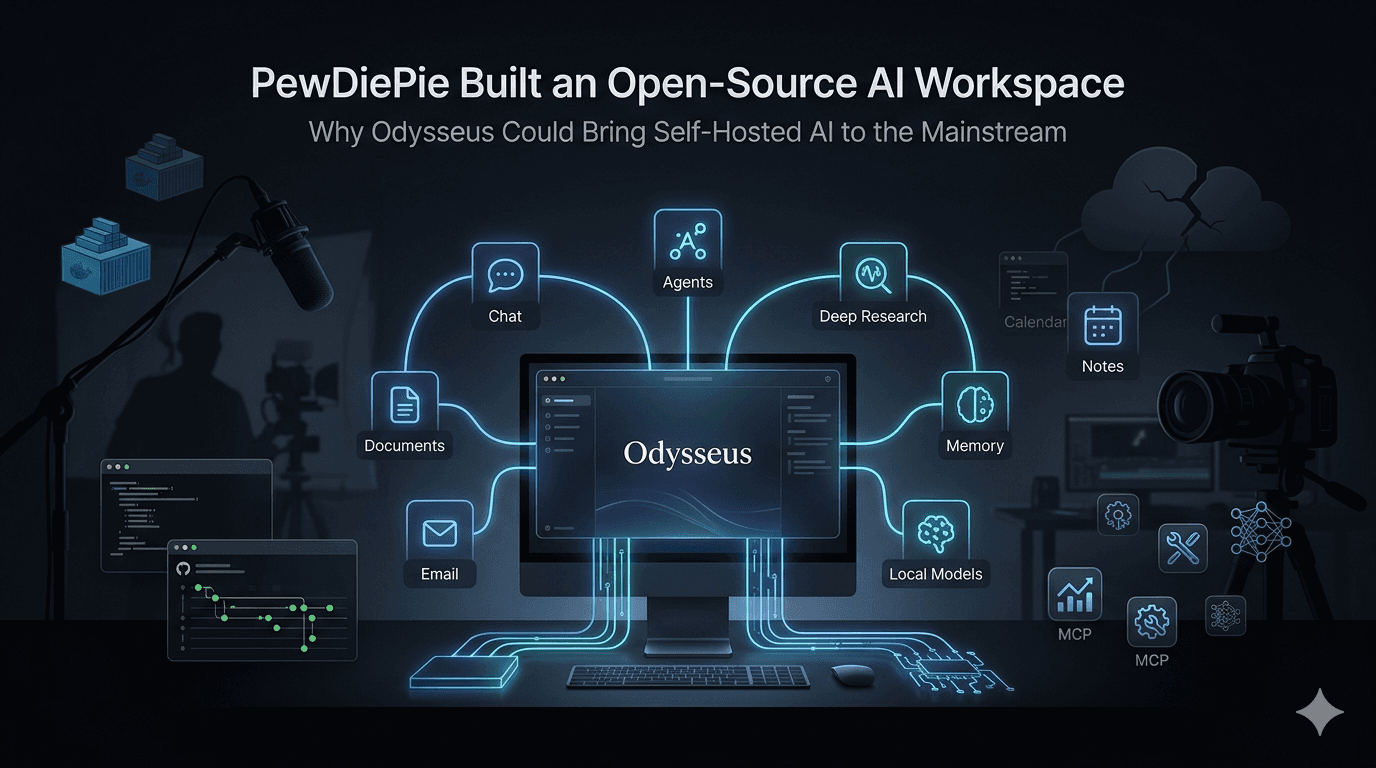
His latest project, Odysseus, is a free, open-source AI workspace that runs on your own hardware instead of someone else's servers. Rather than building another foundation model, PewDiePie built something arguably more practical: a polished environment for interacting with AI privately, locally, and on your own terms.
This Isn't Another ChatGPT Competitor
The headlines often describe Odysseus as a "ChatGPT competitor."
That's only partially true.
Odysseus isn't trying to train the next GPT or Claude.
Instead, it's the workspace that sits on top of language models.
Think of it as an operating system for AI productivity.
It brings together capabilities that developers usually stitch together from multiple tools:
AI chat
Autonomous agents
Deep research
Document editing
Email management
Notes
Tasks
Calendar
Model comparison
Memory
Local model support
API model support
Instead of juggling five or six different applications, Odysseus aims to become the single place where AI work happens.
Local-First Is the Real Story
The most interesting feature isn't the interface.
It's the philosophy.
Every day, millions of people send private code, business documents, contracts, research, and personal conversations to cloud AI services.
Odysseus flips that model.
Run it yourself.
Own your data.
Choose your models.
Control your infrastructure.
That aligns with a growing movement toward self-hosted AI, where privacy isn't an optional setting—it's the default.
Built for Modern AI Workflows
Looking through the repository, it's clear this isn't just a chat interface.
Odysseus includes features that reflect how developers and researchers actually work today:
Tool-using AI agents
MCP integrations
Deep research workflows
Multi-model comparison
Markdown-first document editing
Email drafting and summarization
Scheduled AI tasks
Memory
Local inference with frameworks like Ollama, llama.cpp, and vLLM
This is closer to an AI operating environment than a chatbot.
Why This Matters More Than Another AI Model
The AI industry has spent years racing to build bigger models.
But most people don't train models.
They use them.
The value is shifting from raw intelligence toward the experience surrounding it:
better workflows
better tooling
better orchestration
better privacy
better integrations
Odysseus embraces that shift.
The Open-Source Effect
One of the most surprising aspects of the launch wasn't the software.
It was the community response.
Within days, the repository attracted tens of thousands of GitHub stars and a growing contributor community, showing just how much demand exists for polished, local-first AI tooling.
That's remarkable for any open-source project.
It's even more remarkable considering it comes from someone whose audience was built around gaming and entertainment.
PewDiePie Is Helping Normalize Self-Hosted AI
For years, self-hosting has mostly been the domain of developers.
Docker.
Linux.
Homelabs.
GPUs.
Now imagine introducing those concepts to an audience of over 100 million people.
That's arguably Odysseus' biggest contribution.
It makes self-hosted AI feel accessible.
Not because the technology suddenly changed—
—but because someone with enormous reach decided it was worth building.
It's Not Perfect
Odysseus isn't magic.
Running large local models still requires capable hardware.
Docker setup can be intimidating for newcomers.
And some advanced features demand additional configuration.
If you're expecting a one-click replacement for ChatGPT, you'll probably be disappointed.
If you're looking for an AI workspace you completely control, you'll probably be impressed.
The Bigger Trend
We're entering a new phase of AI.
The conversation is shifting away from:
Which model is smartest?
Toward:
Where does my AI run?
Who owns my data?
Can I customize my workflow?
Can I extend it?
Odysseus fits squarely into that future.
It's less about inventing new intelligence and more about giving users ownership over the intelligence they already have access to.
Final Thoughts
Odysseus probably won't replace ChatGPT or Claude overnight.
That isn't its mission.
Its real achievement is proving that AI doesn't have to live behind someone else's API.
Sometimes the most impactful innovation isn't building a better model.